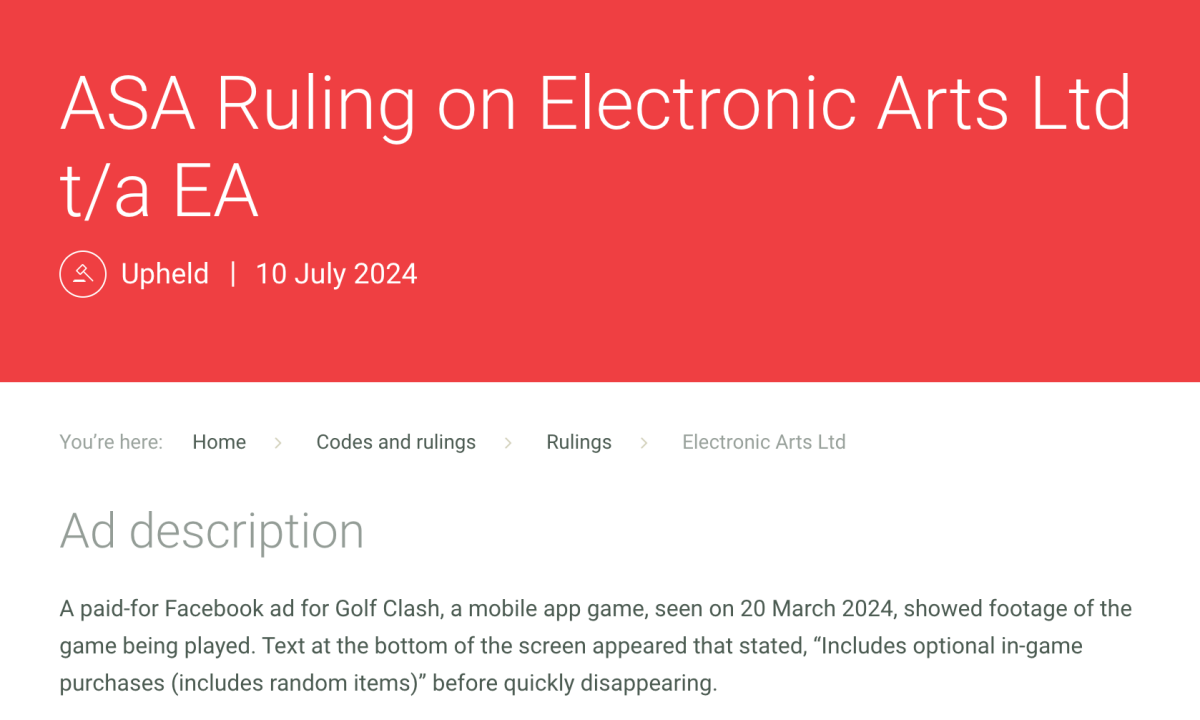
Recently, the UK Advertising Standards Authority (ASA) issued a ruling against a Facebook advertisement for Golf Clash, a game published by Electronic Arts Inc. (EA).
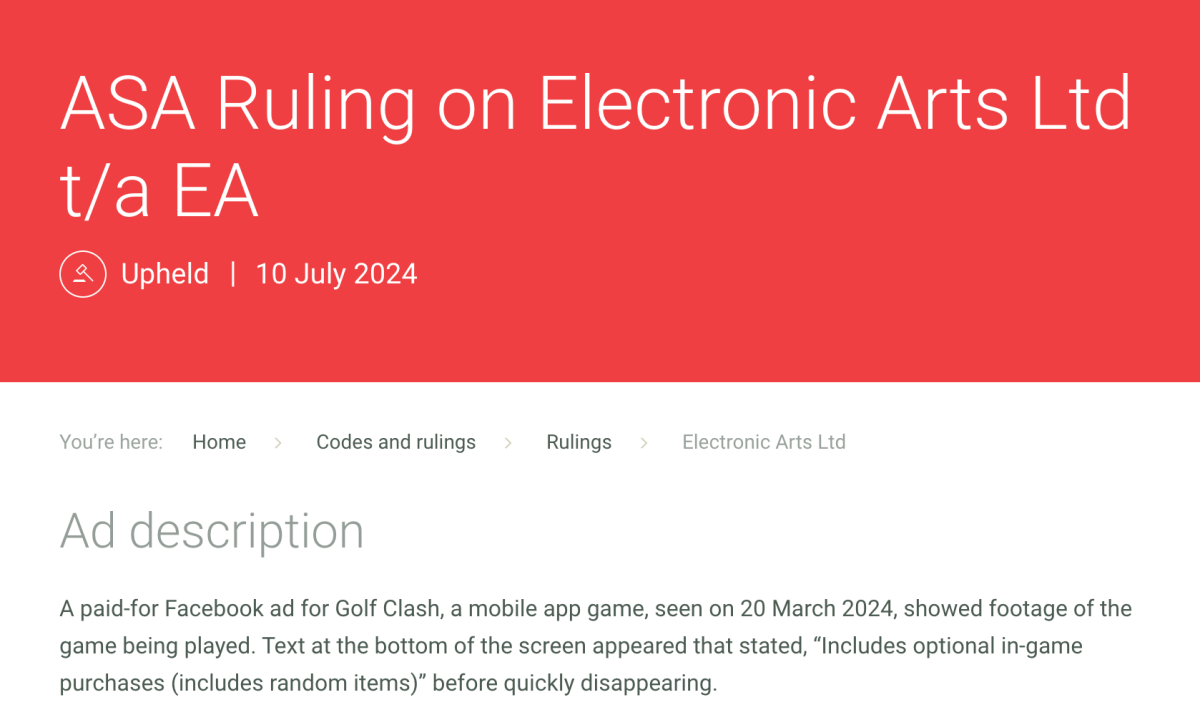
This ruling follows a previous ASA decision issued in March of this year concerning the same game. In the March ruling, one of the two advertisements failed to clearly indicate that the online store contained loot boxes, while the other failed to clearly disclose that the game included in-game purchases or loot boxes. As a result, both advertisements were found to be in violation of Rules 3.1 and 3.3 of the advertising compliance guidelines, as they misleadingly omitted material information. The ASA held that the information provided was insufficient to enable consumers to fully understand the transactional decisions they might make.


In the ruling published on July 10 this year, the disputed advertisement was posted on Facebook on March 20. The content of the advertisement primarily showcased gameplay footage, with text displayed at the bottom stating “Includes optional in-game purchases (includes random items),” which disappeared after a few seconds.
The complainant argued that the advertisement was similarly misleading, as the disclosure appeared only briefly and failed to clearly and prominently indicate that the game included purchases of random items.

In response, EA stated that the disclosure was clearly visible at the beginning of the advertisement and remained on screen for two seconds. EA further argued that the font, spacing, color, capitalization, and layout of the disclosure were designed to ensure its prominence within the advertisement, and that this was sufficient to allow consumers to easily access and directly notice the information. In addition, EA noted that the product description linked to the advertisement clearly stated that Golf Clash included purchases of random items, allowing consumers to become aware of such features before deciding whether to download the game.
In its assessment, the ASA pointed out that the advertising compliance guidelines issued by the UK Committee of Advertising Practice (CAP) state that the existence of in-game purchases, particularly loot boxes, is “material to consumers’ decisions to purchase or download a game.” However, in the disputed advertisement, the disclosure text appeared in light grey font against a background of brightly colored, fast-changing gameplay footage, which distorted the appearance of the text. Combined with the rapid movement of the video footage, the text was difficult to read. Furthermore, the text was small in size and appeared on screen for only two seconds before disappearing.
The ASA concluded that this presentation was insufficient to clearly communicate the existence of in-game purchases to consumers, particularly purchases of random items (loot boxes).
As a result, the ASA ruled that the advertisement breached Rules 3.1 and 3.3 of the advertising compliance guidelines (misleading advertising), prohibited the advertisement from appearing again in its current form, and instructed EA to ensure that information indicating that Golf Clash includes purchases of random items is presented in a prominent and clear manner.
Although the ASA does not possess compulsory enforcement powers, it exerts significant influence within the industry. This ruling demonstrates the ASA’s stringent standards regarding disclosure requirements for probabilistic gameplay mechanics and in-game purchase systems in game advertising. For game companies publishing advertisements in the UK market, strict compliance with the advertising compliance guidelines is essential. Advertisements must not only disclose whether a game includes in-game purchases, but must also ensure that such information is presented in a clear and transparent manner.
In light of this, we recommend that game companies, when preparing advertisements:
(1) use clear and highly visible fonts;
(2) avoid overly cluttered background visuals and maintain sufficient contrast between text and background;
(3) ensure that key information occupies a sufficiently prominent position within the advertisement to avoid being overlooked; and
(4) ensure that disclosures remain on screen for an adequate duration to allow an average consumer to read and understand the information.